Employers: hire trained freshers in volume without running campus logistics yourself.
Colleges & placement cells: get regular employer drives, from skilled to entry-level hiring.
Students: register once, including 10th/12th pass, ITI, diploma, graduates and engineers.
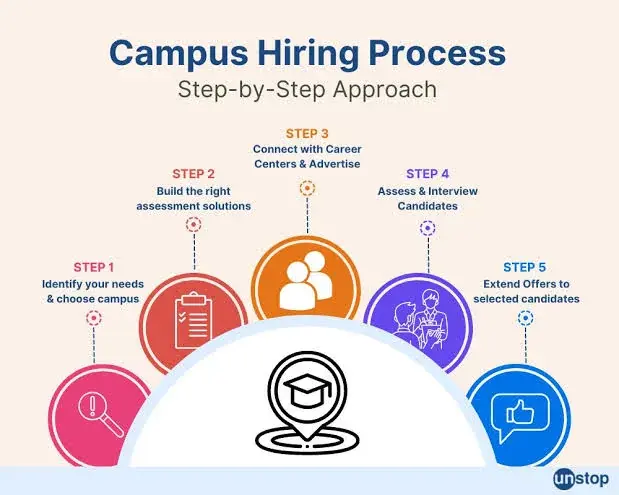
How a drive works
Five steps, one coordinator.
01
Requirement or partnership
Employers share headcount, skills and timeline. Colleges share streams, batch size and availability.
02
Match & plan
We match requirement with suitable institutes and plan the drive.
03
Shortlist & pre-screen
Student shortlisting, basic screening and scheduling.
04
Campus drive
Registration, assessments, interviews and offers coordinated on the day.
05
Joining support
Documentation and joining follow-up.
For employers
Request a campus drive.
Tell us how many students you need and what skills they should have. We plan the drive with suitable institutes.
Campus hiring request
For colleges & TPOs
Bring employer drives to your campus.
Share your institute details and streams. When a matching employer requirement comes in, we reach out to plan a drive. We cannot guarantee drives or placements for every institute.
College partnership
Students: register once.
Final-year or passed out, skilled or not, tell us about yourself and be considered for upcoming drives and openings.
A placement drive that is planned, not improvised.
Good drives are built on preparation by the employer, the college and the students.
For employers
Share a clear job description, eligibility, pay, training and any bond terms. Decide selection rounds and timelines in advance so students are not kept waiting.
Eligibility and branch list
Selection stages and dates
Joining and onboarding plan
For placement cells
Provide dates, student strength by branch, a venue for rounds and a coordinator. We handle communication with employers and share results promptly.
For students
Prepare your resume, revise fundamentals, practise aptitude and communication and carry documents. Ask questions about role, training and growth, and remember that placement is free.
Beyond engineering
Polytechnic, ITI, science, commerce and arts students also have strong opportunities in manufacturing, logistics, retail, services and support operations. We encourage drives across streams.
Illustrative scenario · campus hiring
From a real operating problem to a clearer delivery plan.
These scenarios demonstrate approach and capability. They are not claims about named clients or verified results.
Illustrative
Coordinate a campus drive from eligibility to joining
Illustrative campus programme: employer, placement cell and students use one schedule and a clear set of milestones.
01
The challenge
Students, institute coordinators and employer teams can receive different updates about eligibility, assessment timing, interview results and documentation.
02
The approach
Confirm the role profile, eligibility rules, location, pay details and assessment format before inviting candidates.
Publish a shared drive calendar and one approved communication path for reminders and changes.
Track registration, attendance, assessment, interview, offer and joining status with clear data ownership.
03
What a useful outcome looks like
A more coordinated campus process with fewer unclear hand-offs. Placement outcomes depend on employer participation, candidate eligibility and selection decisions.
Planning · Eligibility · Assessment · Follow-up
Related examples
Three practical ways to apply it.
01
CAMPUS PLANNING
Fix the drive calendar early
Agree dates, eligibility and venue with the placement cell before students are invited.
Read the approach
The challenge
Dates and eligibility change late, and students receive mixed messages.
The approach
Share one calendar, a branch-wise eligibility list and a single coordinator contact with the placement cell and employer.
Intended value
Fewer last-minute changes and a drive that runs on the planned day.
02
ASSESSMENT
Pre-screen students fairly
Use the same aptitude, technical and communication checks for every registered student.
Read the approach
The challenge
Large student groups make consistent screening difficult.
The approach
Define the rounds in advance, brief students on the format and record results in one shared sheet.
Intended value
A transparent shortlist that employers and colleges can both understand.
03
JOINING FOLLOW-UP
Close the loop after offers
Keep students informed from offer to joining day.
Read the approach
The challenge
Selected students lose touch or receive competing offers before joining.
The approach
Share offer terms in writing, confirm documents early and follow up at fixed points before the joining date.
Intended value
A clearer joining pipeline. Actual joining depends on student and employer decisions.
Apply this to your context
Discuss a similar requirement.
Share your goals, constraints and timeline. The next step starts with your actual requirement.